

Lost In Translation/Puyo Puyo
.png)
.png)
| Puyo Puyo | |
|---|---|
 | |
| Manufacturer | Sega / Compile |
| Released | 1992 |
| Control Method |
8-way Joystick 1 Button(s) |
| Main CPU | 68000 (@ 8.949 MHz) |
| Sound CPU | Mono YM3438 (@ 7.670 MHz) SN76496 (@ 3.580 MHz) UPD7759 (@ 640.000 kHz) |
| Video Details |
Raster (Horizontal) 320 x 224 pixels 60.00 Hz 2,048 Palette colours |
| Screens | 1 |
| ROM Info | 5 ROMs 655,360 bytes (640.00 KiB) |
| MAME ID | puyo · puyobl · puyoj · puyoja |
About The Game
Puyo Puyo is an arcade video puzzle game in which players must form chains of four or more beans (known as 'Puyos') of the same colour, causing them to disappear. The player can hinder his or her opponent (either the machine, or a second human player) by forming Puyo combinations; this is because whenever a player forms a successful chain and removes some of his or her Puyos, 'junk' Puyos fall into the opponent's play area, and as Junk Puyos are transparent, they cannot be used to form a chain and can only be destroyed when a nearby chain is created.
Trivia
Released in October 1992.
Puyo Puyo is Japanese onomatopoeia for the sound that a rather plump person might make.
For fanatics, here is the full cast :
- Silvana
- Skeleton
- Blue Ghost
- Mummy
- Dragon Woman
- Goby Captain
- Small Foot
- Dark Elf
- Scorpion Man
- Johnny
- Zombie
- Witch
- Elephant
- Lord
- Devious
- Max Minotaur
- Lulu
- Dark Prince
- Carbuncle
Puyo Puyo was originally released by Compile in 1991 for the MSX2 under the name Puyo Puyo. It was soon followed by a version for the Nintendo Famicom Disk Drive called 'Puyo Puyo Disk Drive' (featured characters from the 1989 RPG Madou Monogatari, also made by Compile). Puyo Puyo only really became popular when it was released as an arcade game in 1992. This was the first version that included a one player story mode, in which the human player plays against computer opponents of increasing difficulty. This feature was an immediate success because it allowed players to play by themselves. Future versions of Puyo Puyo for home systems also included this feature (see 'Ports' section for more info).
Series
- Puyo Puyo (1991, MSX2)
- Puyo Puyo Disk Drive (1991, Nintendo Famicom Disk)
- Puyo Puyo (1992)
- Puyo Puyo 2 (1994)
- Super Nazo Puyo - Ruruu no Ruu (1995, Nintendo Super Famicom)
- Super Nazo Puyo Tsuu - Ruruu no Tetsuwan Hanjouki (1996, Nintendo Super Famicom)
- Puyo Puyo Sun (1996)
- Puyo Puyo Da! (1999)
- Puyo Puyo 4 - Puyo Puyo Party (1999, Sega Dreamcast)
- Puyo Puyo Fever (2003)
- Puyo Puyo Fever 2 [SLPM 66104] (Nov.2005, Sony PlayStation 2)
- Kidou Gekidan Harouza Haro Ichiza - Haro no Puyo Puyo (2005, Nintendo Game Boy Advance)
- Puyo Puyo! 15th Anniversary (2006, Nintendo DS)
Cabinet and Artwork
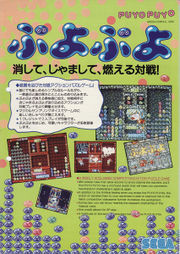
Puyo Puyo flyer.
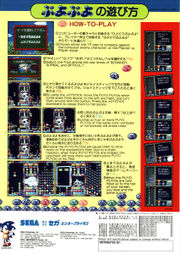
Back of the Puyo Puyo flyer.
.jpg)
_(back).jpg)
Ports
- Consoles
- Sega Mega Drive (1992)
- PC-9801 (1992)
- Sega Game Gear (1993, "Puzlow Kids")
- Nintendo Famicom (1993)
- Nintendo Super Famicom (1993, "Super Puyo Puyo")
- NEC PC-Engine Super CD-ROM2 (1994, "Puyo Puyo CD")
- Nintendo Game Boy (1994)
- FM Towns Marty (1994)
- Sony PlayStation (2000, "Puyo Puyo Box")
- Computers
- Sharp X68000 (1994)
- PC [MS Windows 95] (1995)
- Others
- Mobile phones (2001)
Soundtrack Releases
| Album Name | Catalogue No. | Released | Publisher | Comments |
|---|---|---|---|---|
| Puyo Puyo RaveRevenge | CPCD-PY04[1] | 1993-05-20 | COMPILE / LMS Recordings | CD version. |
| Rare Tracks / Tanaka, Katsumi | EMCA-0001[2] | 2007-08-24 | Egg Music | CD version. |
| RARE TRACKS -Version 3rd Reissues- | N/A[3] | 2008-04-14 | iTunes | Digital download only. |
| Puyoman | TECD-18441[4] | 1999-03-25 | Teichiku Records | CD version. |
| Puyo Puyo DX. Complete Best Album 1 | TECD-25409[5] | 1998-07-23 | Teichiku Records | CD version. |
References
- ↑ Puyo Puyo RaveRevenge (CD) at the VGMdb
- ↑ Rare Tracks / Tanaka, Katsumi (CD) at the VGMdb
- ↑ RARE TRACKS -Version 3rd Reissues- (Digital Download) at the VGMdb
- ↑ Puyoman (CD) at the VGMdb
- ↑ Puyo Puyo DX. Complete Best Album 1 (CD) at the VGMdb

